
Following its qualification by the EMA earlier this year, PathAI’s AIM-MASH AI Assist* has now been qualified by the FDA for use in phase 2 and 3 MASH clinical trials to aid pathologist review of liver biopsies for the purposes of trial enrollment and primary/secondary endpoint histology assessment for accelerated approval. This is the first AI-powered pathology tool to receive FDA qualification through the Drug Development Tool (DDT) Biomarker Qualification Program. Prior to its qualification, AIM-MASH AI Assist underwent extensive analytical and clinical validation and demonstrated:
- Non-inferiority to average individual pathologists for scoring fibrosis and steatosis1,2
- Superiority to individual expert manual reads for scoring ballooning, inflammation and determining clinical trial enrollment and endpoint criteria,1,2 and
- Superior reproducibly compared to manual scoring1,2
This approval clears the way for prospective incorporation of AIM-MASH AI Assist into clinical trials, begging the question – how can AIM-MASH AI Assist impact primary endpoints for MASH?
To answer this question, we will examine results from the Phase 2 WAYFIND trial, which were presented at AASLD’s recent The Liver Meeting.3 The goal of this trial was to evaluate the efficacy and safety of semaglutide (SEMA) plus cilofexor and firsocostat (CILO/FIR) in patients with compensated cirrhosis due to MASH.
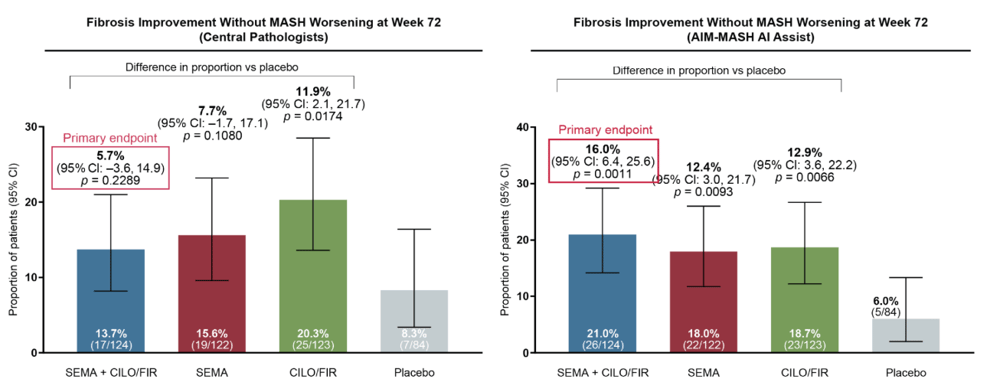
Figure 1. The WAYFIND trial did not meet its primary fibrosis improvement endpoint by manual histology scoring (left) but did meet this endpoint using AIM-MASH AI Assist (right)
The proportion of enrolled patients achieving fibrosis improvement without MASH worsening at week 72 is shown in Figure 1. The combination regimen of SEMA + CILO/FIR (blue bars) did not achieve this primary endpoint by manual scoring. Importantly, when this endpoint was measured using AIM-MASH AI Assist, SEMA + CILO/FIR achieved fibrosis improvement without MASH worsening. SEMA alone and CILO/FIR alone also achieved fibrosis improvement without MASH worsening when AIM-MASH AI Assist was utilized.
These results indicate that WAYFIND would have met its primary endpoint if the study design had included the validated AIM-MASH AI Assist read workflow1 for planned histological assessment of endpoints. Given the lack of approved therapeutics for the WAYFIND study population (patients with compensated cirrhosis due to MASH), the success of the WAYFIND trial could have expedited the approval of sorely needed interventions for these patients.
The FDA qualification of PathAI’s AIM-MASH AI Assist is a pivotal moment in digital pathology and hepatology, marking the first time an AI-powered pathology tool has been cleared for use in drug development. As demonstrated by the WAYFIND analysis, the proactive incorporation of this tool into trial design has the power to overcome the limitations of manual scoring, potentially turning a failed primary endpoint into a successful one. This success enables not only increased precision and reproducibility in clinical trials but, most importantly, the acceleration of sorely needed interventions for patients with MASH, fundamentally redefining the path to therapeutic approval.
*AIM-MASH AI Assist is qualified as a tool in the EU and as a DDT in the US for use in MASH clinical trials. AIM-MASH AI Assist is not for use in diagnostic procedures.
References:
- Pulaski H, et al. Clinical validation of an AI-based pathology tool for scoring of metabolic dysfunction-associated steatohepatitis. Nature Medicine. 2025;31:315–322. doi:10.1038/s41591-024-03301-2.
- European Medicines Agency (EMA). Qualification Opinion — Artificial Intelligence-Based Measurement of Non-alcoholic Steatohepatitis Histology in Liver Biopsies to Determine Disease Activity in NASH/MASH Clinical Trials. EMA/CHMP; 2025.
- Alkhouri N, et al. A Randomized, Placebo-Controlled, Phase 2 Study of the Safety and Efficacy of Combination Treatment with Semaglutide, Cilofexor and Firsocostat in Patients With Compensated Cirrhosis Due to Metabolic Dysfunction-Associated Steatohepatitis (WAYFIND). Hepatology. 2025; 82(S1):S131-S133.